Nobody sends a memo when your business starts dying. There is no alarm. There is a slightly quieter inbox, a refund you shrug off, and a customer who “just needs a break for a while.” You are busy, so you file all three under normal.
Two decades of building marketing software buys you a front-row seat to how this plays out. A company celebrates record numbers. The slides look perfect. The mood feels unstoppable. Meanwhile, somewhere off to the side, somebody smaller is building a smoother option that skips the whole model, and the people closest to the customers hear about it every single day.
Those warnings rarely make it up the chain in a clean, honest way. They get softened at every step. Then the floor gives out, everyone calls it sudden, and nobody wants to talk about the eighteen months of warning that came first.
Most businesses don’t fail because people are lazy. They fail because they miss the market shift right in front of them.
Rita McGrath wrote a whole book about this called Seeing Around Corners. One line of hers stuck with me: disruption is not a sudden explosion. It is the slow breakdown of assumptions you keep ignoring. What follows are the ten truths I pulled out of that book, run through the filter of a guy who has owned a rental car franchise, restored muscle cars, brokered domains, and shipped software for twenty-plus years. Every one of those businesses had an edge that knew things before the books did.
1) Disruption starts as a whisper, then turns into a shout
Businesses rarely collapse overnight. They weaken in small ways first, and then one day the drop looks sudden. It wasn’t. The big changes grew in the shadows while everyone kept watching the old metrics.
Hearing aids are my favorite example. For years they lived inside a medical system. Audiologists controlled access, the price was brutal, and most people who needed one never bought one. Only a small slice of the market got served.
Then consumer audio kept improving. Bose, Samsung and the rest pushed earbuds that amplify sound, and they did it completely outside the medical gatekeeping. The audiologists never saw a competitor. They saw a gadget.
Your biggest threat may not look like your competitor. It may look like a totally different category.
2) The edge knows before the corner office does
In most companies the top is the last place to feel change. Reports get cleaned up on the way there. Bad news gets rounded down. So the executive dashboard stays calm while the market heats up, which is a bit like checking the weather by looking at yesterday’s sky.
The real signals live at the edges. Support tickets. Sales calls. The way people actually use the product versus the way you designed it. The engineer who mutters that customers keep asking for the same weird thing.
- Listen for the complaint that shows up three times in one week.
- Track what people do with your product, not what your onboarding hoped they would do.
- Watch platform changes: privacy rules, device updates, algorithm shifts.
- Take the odd requests from power users seriously. They are early.
If you run a solo business, you still have an edge. It is your inbox, your refunds, and your churn. That is your early warning system, and it only works if you are willing to look at it on a bad day.
3) Punish bad news once and you will never hear it again
When leaders shoot messengers, teams stop sharing hard truths. That’s not evil. It’s human nature. Over time the whole company starts communicating in a feel-good story. It sounds confident. It just isn’t real. You are reading a movie script instead of a map.
Back when I had a crew working under me, the only reports I trusted came from talking straight to the people doing the work. Anything that traveled through a layer first arrived pre-softened.
If you’re a solopreneur, there is no layer to blame. Your filter is your ego. You reread the praise and skim the warning signs. I’ve done it. It feels great right up until it doesn’t.
Four things to do this week:
- Call three customers who stopped buying and ask why. Then be quiet and listen.
- Stop celebrating page views if conversions are falling.
- Track where people drop out of your funnel, not just how many walk in.
- Reward honesty, even when it stings. Especially then.
4) When everybody agrees, somebody is missing from the room
When everyone thinks the same way, planning feels smooth. Meetings end fast. Nobody argues. That comfort is the problem. If your group shares the same background and the same incentives, you will all miss the thing an outsider would spot in five minutes.
McGrath calls the fix a Strategic Red Team. Their one job is to prove that your current best product is already dying, using data instead of drama. You don’t need a department for this. You need a habit.
- Ask a founder from a completely different industry to tear your plan apart.
- If you sell online, get a Gen Z opinion. They will tell you what is already dated.
- Ask one question out loud: “What would make our offer irrelevant in two years?”
If your strategy has never been challenged, it isn’t a strategy. It’s a guess with confidence.
5) Most decisions are a screen door, not a vault door
Plenty of businesses slow to a crawl because they treat every choice like a life-or-death bet. Paralysis follows. The fix is to sort decisions into two buckets before you agonize over them.
- Type 1: Hard to undo. High stakes. Real money or real reputation on the line. Signing a long lease. Selling the company.
- Type 2: Easy to undo. Low risk. A new pricing tier. A different headline on the landing page. A test ad with a coffee-money budget.
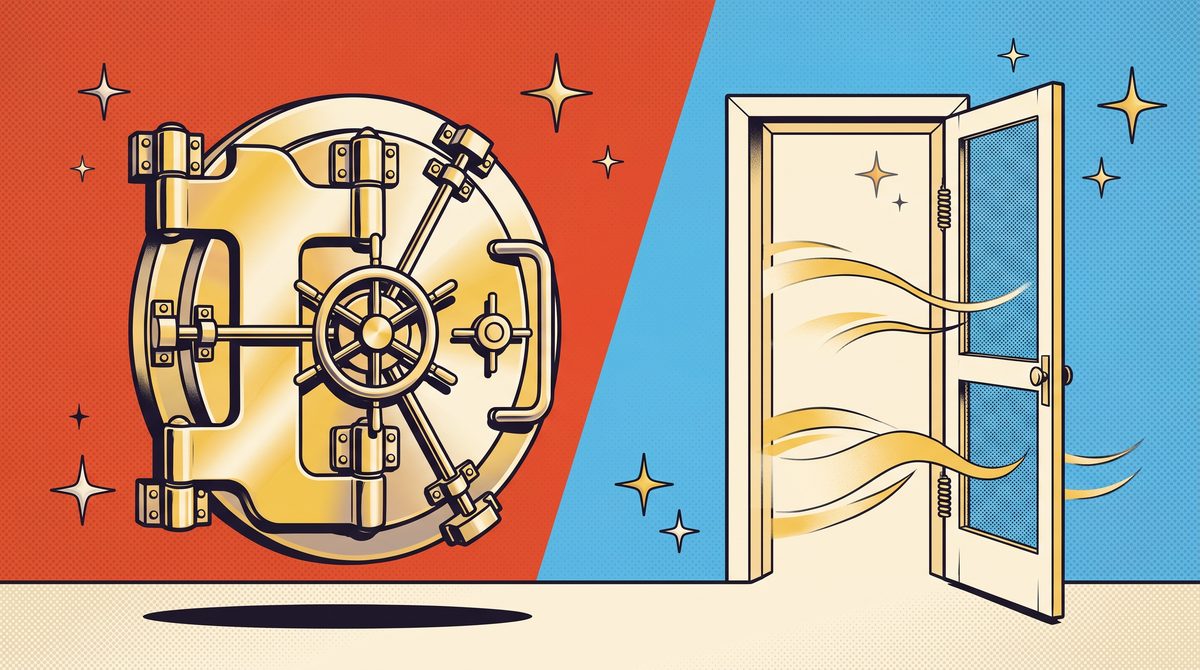
Weak businesses treat Type 2 decisions like Type 1. They hold meetings, wait for perfect data, and miss the moment. Your whole advantage as a lean operator is speed. Protect it like it pays the bills, because it does.
6) Your bank balance is a rearview mirror
Profit reports are lagging indicators. They tell you what already happened. By the time revenue drops, the real problem usually started months ago. The damage just took a while to show up on paper.
To see around corners you need a mix of numbers.
- Lagging: quarterly profit, annual churn, total sales. The history book.
- Current: daily active users, usage rates, support volume. The dashboard.
- Leading: early sentiment, policy shifts, new tools your customers are trying. The windshield.
If cash in the bank is the only number you watch, you are driving by the rearview mirror. Add one leading indicator to your weekly routine. Just one. It changes what you notice.
7) By the time you are certain, it is too late to be cheap
Here is the paradox. When the signals are weak, you still have room to move. You can test, shift, and reposition for almost nothing. When the proof becomes obvious, everyone can see it, the market has already moved, and your options get expensive fast.
McGrath’s tool for this is a Time Zero trigger: a clear line that, once crossed, forces a change. Write yours down.
- “If half my clients start using AI agents for this, my service has to change.”
- “If a platform cuts my reach in half, I need a new channel, not a complaint.”
Then work backward. What weak signals would show up before that line gets crossed? Those signals are your early move window, and they are a lot cheaper to act on than the headline.
8) Nobody buys your category. They buy less hassle.
Customers don’t wake up thinking about your industry label. They wake up with a problem and want it gone with the least friction possible. That is why disruption so often comes from outside your category. Someone solves the same job with fewer steps.
Teen clothing brands didn’t only compete with other clothing brands. They competed with smartphones, because a phone delivers status and connection faster than a hoodie does. Gillette didn’t lose because its blades got worse. Dollar Shave Club removed the trip to the store. Convenience beat tradition, and it usually does.
One question worth writing on a sticky note: what job is my customer hiring me to do, and who else could do it faster?
9) If your profit depends on annoying people, the clock is running
Some business models make money by trapping customers. Confusing terms. Hidden fees. Switching costs designed to hurt. It works right up until someone shows up with a cleaner deal, and then customers leave in a hurry, because they were never happy in the first place.
Blockbuster made a fortune on late fees. Taxis had messy payments and unreliable pickups. Old software contracts locked people in for years. Then Netflix and Uber showed up smooth, and the old friction became impossible to defend.
Audit your own offer with three questions.
- Where do customers feel stuck with you?
- Which part of your process feels slow or confusing?
- What would a “one-click” competitor remove first?
Remove that friction before somebody else does it for you. That is how you keep trust, and trust is the only moat a small operator really has.
10) In a fog, plan to learn instead of planning to be right
When markets move fast, long plans break fast. Your three-year projection is a work of fiction with a spreadsheet attached. McGrath’s answer is Discovery-Driven Planning, and it fits a small business better than it fits a big one.
Think of it like building a plane while testing the parts. You don’t spend big until the basics prove out.
- Decide the profit that makes the project worth doing at all.
- Work backward to the most you can afford to spend to get there.
- List every assumption you are making about customers and demand. All of them, even the embarrassing ones.
- Fund checkpoints, not timelines. Learning drives the spending, not the calendar.
Before you build the full course or the big product, run a cheap test. A small ad. A presale page. A pilot offer to ten people. The market will tell you more in a week than your spreadsheet will in a year.
The 30-minute audit
You don’t need a retreat or a consultant. You need a notebook and enough honesty to write down the uncomfortable answer.
- Write your core assumption. “Clients will keep paying for X.” Now stare at it.
- Name the biggest friction. What do customers tolerate but quietly dislike?
- Track the edge. List three tools your audience uses that have nothing to do with your niche.
- Set a Time Zero trigger. One event that would make your offer obsolete.
- Run a $50 Type 2 experiment. Test one offer that removes one piece of friction.
The part that changes
Long-haul survival has very little to do with working 80 hours a week. It comes down to awareness: noticing the small shift before it becomes the big shock, while it is still cheap to do something about it.
That is the shift I want for you. Less dread about the quarter you can’t see yet, and more confidence that you would catch it early if things turned. The clues are already there. They live in complaints, churn, new tools, and changing habits. You just have to look at the edges.
So pick one weak signal in your business this week and act on it. And if you want more of this in your inbox, join the Pit Crew. One email a week, no pitch parade.