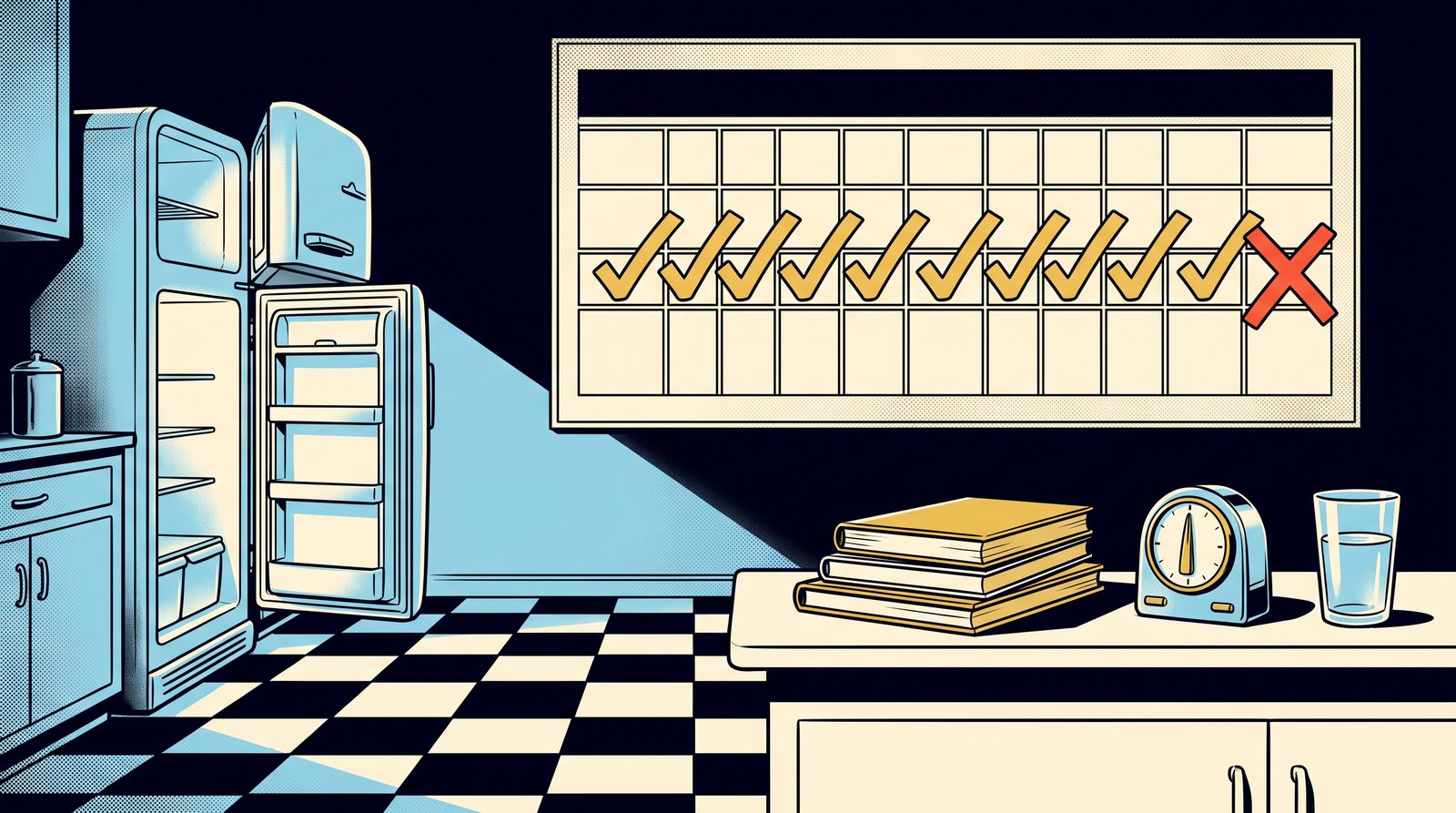
Here is the scandal nobody in wellness tech wants printed: every habit app on your phone was built for a person who is already calm, already rational, and already in control.
That person does not exist at 11 PM on Day 3.
A software developer on Reddit spent an entire Sunday building the perfect habit-tracking setup. Color-coded streaks. Three apps. A $30 journal. Eight minutes into his first real argument that week, he was back on nicotine.
His post-mortem was one sentence long, and it belongs on the wall of every product team in the category.
“Tracking a red X on a screen doesn’t tell me what to do with my hands when my brain is on fire.”
The receipts: a multibillion-dollar business built on recording failure
Wellness apps were an $11.3 billion market in 2024, by Grand View Research’s count, and the mental health slice alone is growing about 14.6 percent a year through 2030. That is a lot of money for streak counters, mood logs, and empty calendars.
Look at what those products actually do. They record. They ask you to open the app, rate your day, and admire (or mourn) a chain of check marks. Every one of them is designed for the moment you are least likely to be in: sitting quietly, thinking clearly, choosing well.
The moment that matters looks nothing like that. It is late, you are tired, somebody said the wrong thing, and the part of your brain that makes good decisions has gone offline. That part is biology, and no app has a fix for biology. Handing that person a blank calendar is a product failure, and it is a repeatable one.
Then there is the gap in what the market offers. On one side, free advice: drink a glass of water, take a walk, the same five tips recycled across every blog on earth. On the other side, a licensed therapist or habit coach at $150 to $300 an hour. In the middle sits an enormous crowd of people who are motivated, self-aware, willing to pay, and have nowhere to go.
The subscription model has no reason to close that gap. A tracking loop that never ends is worth more to an app than a customer who actually recovers.
You didn’t fail the app. The app failed the moment.
If you have a graveyard of habit apps on your phone, the industry has a word for you: churn. I have a different one: normal.
You weren’t weak at 11 PM. You were handed a scoreboard when what you needed was a script.
A broken 12-day streak does not teach you anything. It produces a crash, and the crash is what sends most people all the way back to square one. The tools were measuring the problem. Nobody was solving it. Every relapse just became one more data point for a product that was never going to change.
The fixes that keep getting tried
More tracking. A second app to watch the first one. Widgets, streak insurance, a journal on the nightstand. The developer in the Reddit post did all of it in one Sunday and lasted eight minutes.
More community. Forums, group chats, accountability buddies. Useful right up until an unmoderated thread at midnight becomes the trigger it was supposed to prevent.
More willpower. The industry’s favorite, because it costs them nothing to recommend. Nobody sells willpower by the pound, which is convenient, because nobody has to refund it either.
Now watch when people actually go looking for help. Late at night after a slip. First thing Monday with the weekend still sitting in their chest. Not 2 PM on a Tuesday with a latte and a clear head. Every product in the category is priced, designed, and marketed for the Tuesday buyer, and the Tuesday buyer is not the one in trouble.
Then a build sheet surfaced
Zack Liu, who writes the Solopreneur Lab newsletter, took that Reddit post apart and drew up what the wellness giants have not shipped: a $19 product built for the breaking point instead of the calm afterward.
The evidence is uncomfortably specific. Ten intake questions: which habit, how often, when the cravings peak, where you are when they hit, where you relapsed before, and why you want out. Sixty seconds after payment clears, a personalized 30-day plan lands in your inbox as a PDF. No account. No password. No streak. No feed.
Four sections do the work. A three-step physical interrupt timed to fire 15 minutes before your peak craving window. One concrete action for every one of the 30 days. A single printable cheat sheet for the bathroom mirror, not the phone. And a zero-guilt relapse reset that treats a slip as data and points you back at your own reason for quitting.
What got left out matters just as much. No accounts, because forgotten passwords kill more tools than bad features do. No streaks, because a broken streak is a relapse trigger with a progress bar. No daily check-ins, no community feed. It does not ask you to think. It makes the right action the only one available.
The math that should embarrass the funded competition
The whole thing runs on six plain tools: Tally for the form, Make for the automation, the OpenAI API for the writing at about three cents a plan, APITemplate for the PDF, Postmark for delivery, and a Carrd page with a Stripe link. Fixed overhead: zero to about $24 a month. Cost to fulfill a $19 order: roughly 92 cents. Build time: one weekend, no developer.
At $19, $2,000 a month is about three and a half sales a day. Two checkout upgrades, a morning text ping for $14 and a partner playbook for $17, push the average order to about $28, and $10,000 a month becomes roughly a dozen sales a day. Plain disclaimer, in my own words: that is a spreadsheet, not a promise, and anyone’s results would depend on the offer, the audience, and how consistently they ran it.
One line that is not optional, on the landing page and on page one of every PDF: this is habit planning, not medical advice or addiction treatment, and anyone facing physical withdrawal needs a licensed professional, not a PDF.
The questions the industry now has to answer
If one person with $24 of overhead and a free weekend can build a more useful crisis tool than companies with millions in venture capital, somebody has some explaining to do. Who benefits from keeping you inside a tracking loop instead of getting you out of one? And why did it take a Reddit post at 11:30 at night to say the quiet part out loud?
The investigation is yours to finish. Start with what you would build for the moment the apps ignore, and if you want the next one of these in your inbox, join the Pit Crew. One email a week, no pitch parade.