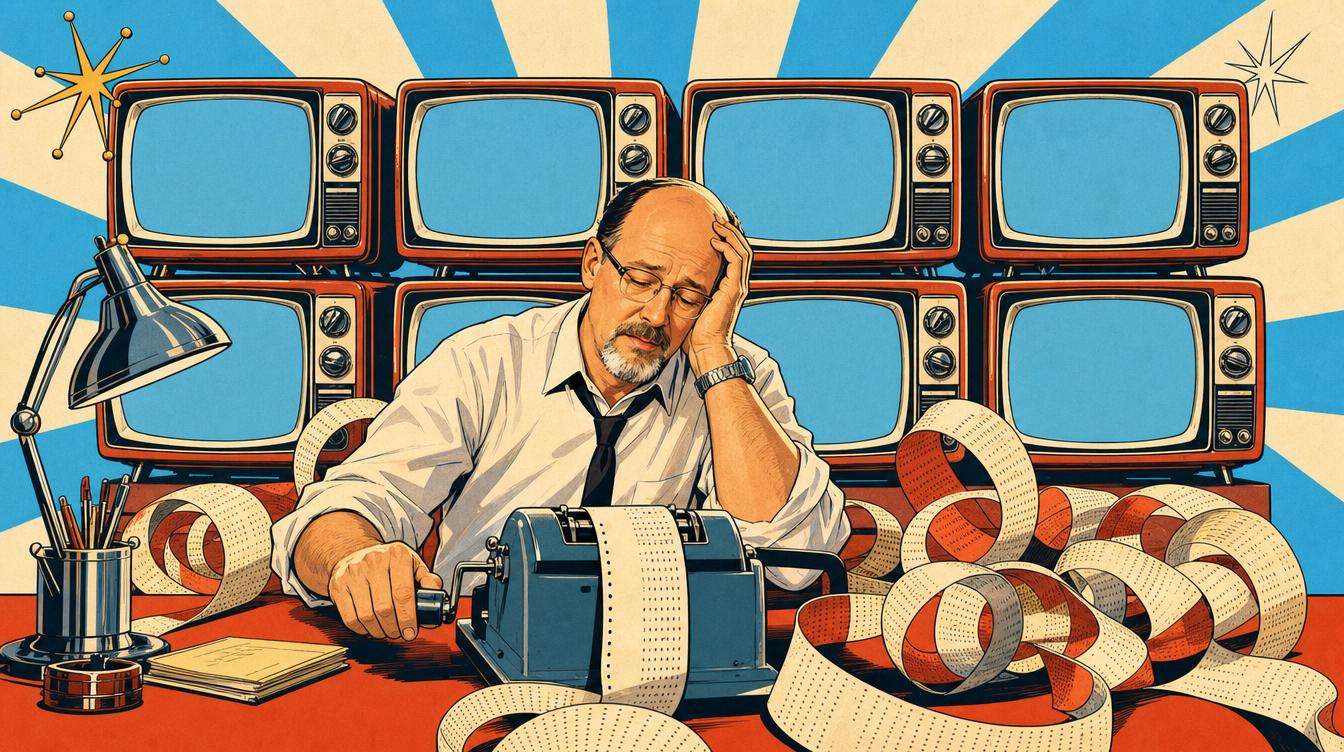
Every marketing guru on the internet gives you the same advice.
Post more. Be consistent. Show up everywhere your customers are.
And here's the uncomfortable part: they're right. Consistency works. The algorithm rewards it. The audience compounds. The leads show up without ad spend.
But there's a piece of that advice nobody says out loud. A piece they conveniently leave off the slide. And once you see it, you can't unsee it.
The advice isn't wrong. It's incomplete. And the missing piece is the reason you've tried "being consistent" four separate times and quit all four.
The math they don't show you
Let's actually run it.
Your customers are on TikTok, Instagram, Facebook, LinkedIn, X, YouTube, Reddit, and email. Not one of those. All of those: the average user is active on more than six platforms at once. 5.79 billion people, scrolling right now.
"Show up everywhere" means writing for all eight.
Except a post that lands on LinkedIn reads like a press release on Facebook. A Reddit thread that builds real community looks like spam on X. TikTok wants a hook in the first two seconds. LinkedIn rewards the slow build. You're not writing one post. You're writing eight different versions of it, in eight different formats, with eight different psychologies.
That's just the writing. Now add video.
Video is over 60% of everything consumed on social media. Eight in ten people say a video influenced something they bought. YouTube Shorts alone pulls 70 billion views a day. If your feed is text-only, you're invisible in the format where attention actually lives.
And making one video isn't writing a post. It's a script, visuals, captions, a length per platform, an export, a format, an upload. 37% of marketers who don't do video quit for one reason: they don't know where to start.
Add it up honestly and "just be consistent" is a 10-to-15-hour-a-week job. Every week. Forever.
That's the exposé.
The best marketing advice on the internet quietly assumes you have a content department. You have a Tuesday afternoon.
You weren't lazy. You were doing the math.
Here's what I want you to sit with for a second.
Every time you started strong and faded by week three, that wasn't a discipline problem. Your gut ran the numbers before your calendar did. Ten hours a week against everything else you're carrying? Something had to lose. Content lost.
I know because I lost the same fight. Publicly.
In four months, my partner Wayne and I shipped four products. Four real products, built, tested, ready to sell. Three of them sat completely dark: no posts, no campaigns, no story told anywhere. Not because they weren't good. Because after promoting the first one, there were no hours left in the week. Revenue we built those products to earn, sitting quietly on the table.
So I did what everyone tells you to do next.
The three "fixes" that aren't
I tried the tool stack. HeyGen for video, Canva for graphics, a scheduler, an AI subscription or two, stock footage. Call it $150 to $300 a month, and I was still the one doing 10+ hours of production. I didn't buy a solution. I bought more dashboards.
I tried a VA. Capable guy. But the review loop ate me alive: first draft, rewrites, three rounds before anything was close. It still didn't sound like me. No hook, no voice. By the end I'd spent more hours managing the writing than writing it.
Turns out the cheapest way to get content that doesn't sound like you is to pay someone else to write it.
And the agency route? $3,000 to $5,000 a month, 30 to 60 days of onboarding before a single post ships. For most solo operators and small shops, that's not a fix. That's a second mortgage on a problem you already can't afford.
Three paths. All of them trade money for time or time for money, and none of them fix the part that actually matters.
The part that actually matters
Because here's the second thing the "post more" crowd never mentions: most of what gets posted doesn't work anyway.
Feature-first content (here's my product, here's what it does, buy now) gets a like at best. A peer-reviewed study of more than 85,000 Facebook posts found that story-based content converts 20 to 30% higher than feature-driven messaging. Narrative got shared. Features got scrolled.
And sharing is the only metric that grows an audience without paying for it.
Short-form video gets shared 1,200% more than text and images combined. Story-driven short-form video is the single most leveraged piece of content you can make, and it's the exact piece the math says you don't have time for.
So the real problem was never "post more." It was this: how does one person tell a real story, in a voice worth reading, in eight formats, with video, every day, without it becoming their entire life?
I complained about that question for months. Wayne answered it by sharing his screen.
What the fix actually looks like
He'd already started building it. I watched a working version of everything I'd been describing run in front of me, and today it's the tool our whole operation runs on. It's called MarketMasher.

Here's the whole workflow: you paste a URL. Your sales page, an affiliate link, a blog post. Anything with a link.
A swarm of AI analysts reads the page, picks the angle, and builds the full marketing brief in about a minute. You answer zero questions. Then you pick the voice the story gets told in: 26 trained voices built on the frameworks of the best storytellers and copywriters who ever did it. Content written in the style of Donald Miller when you want story. In the style of Dan Kennedy when you want the close.
It writes the copy for all eight platforms, natively: the Reddit post reads like Reddit, the LinkedIn post reads like LinkedIn. It generates the images. It makes the actual short-form videos, captioned and formatted, no camera, no editor. Then AutoPilot posts fresh versions on the schedule you pick: new copy, new images, new videos every cycle, while you're building the next thing.
Ten hours a week became about ten minutes per campaign.
And the three quiet products? They're not quiet anymore. Our own early campaigns (small, real, fully trackable) did $133.50 in affiliate sales with zero ad spend, $1,491 in launch sales from Facebook and TikTok posts alone, and roughly 9× our usual engagement the moment video entered the feed. Early-stage proof, not income promises. Your results will depend on your offer, your audience, and how consistently you run it.
But consistency is the one part that's finally not my job anymore.
The advice was right. The assumption was wrong.
Post more. Be consistent. Show up everywhere.
Still true. It was always true. The lie was the unspoken assumption underneath it: that you'd do it all by hand, forever, alone.
You know your product. You know your customer. You could tell the story in your sleep. The only thing standing between you and "consistent" was ten hours a week that don't exist.
Now they don't have to.
Paste one URL at marketmasher.com (300 free credits, no card, no catch) and watch what your marketing looks like when the math finally works in your favor.